Market Access to West Africa Through B2B Distribution
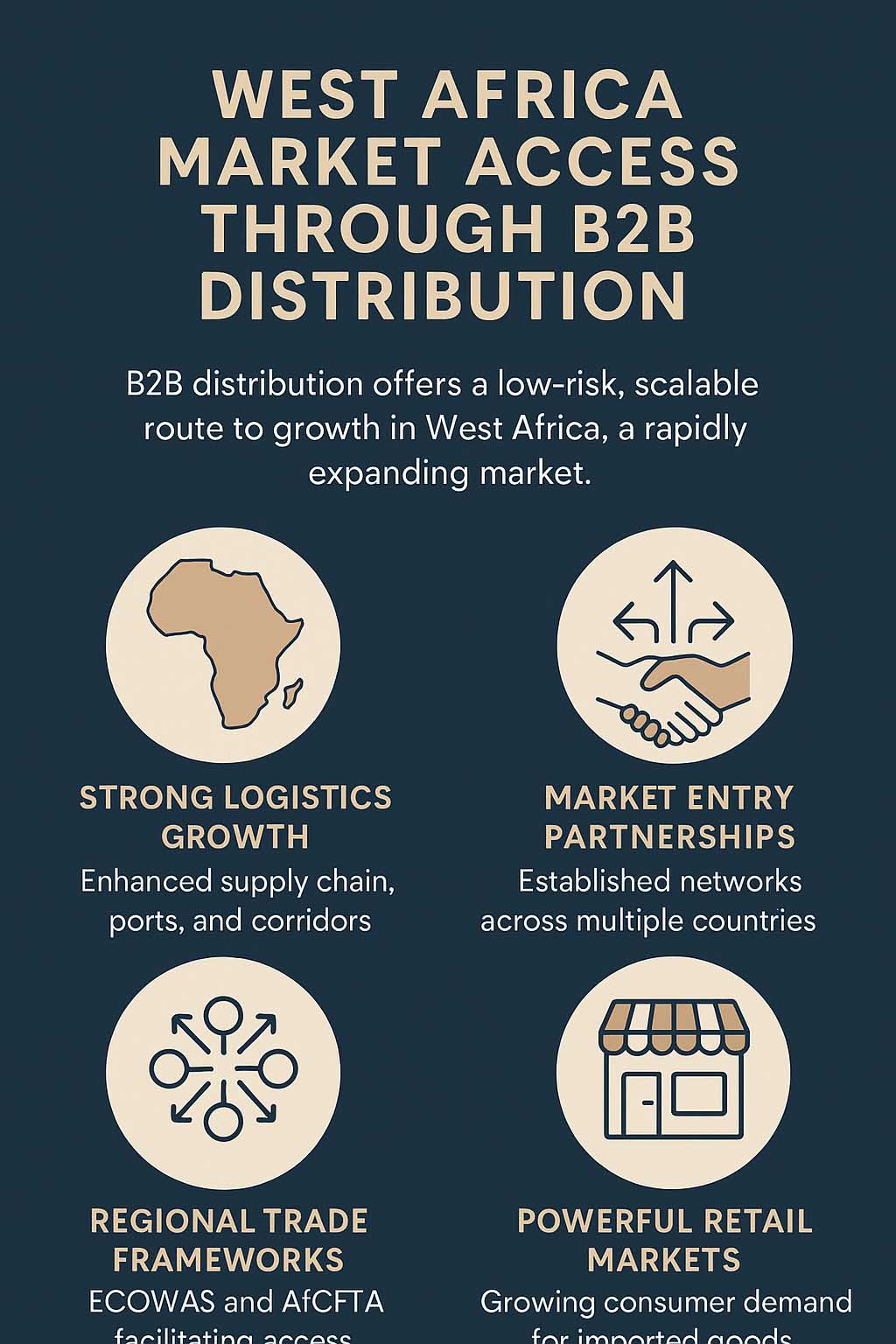
West Africa has become one of the fastest‑growing trade corridors globally, driven by rising consumer demand, increasing urbanization, and rapid improvements in logistics infrastructure. For businesses aiming to enter or expand within the region, B2B distribution has emerged as the most reliable and scalable route to market. This article explores why West Africa represents a high‑potential opportunity and how B2B distribution models provide the strongest pathway to commercial success.
🌍 Why West Africa? A Region on the Rise
The region’s economic and consumer landscape has been transforming rapidly. Urbanization, digital adoption, and growing middle‑class spending continue to expand retail and FMCG markets. According to Maersk’s 2025 analysis, Nigeria, Ghana, and Senegal have become major FMCG hubs, supported by modernized supply chains and regional trade integration efforts such as ECOWAS and AfCFTA.
In addition, the West Africa logistics sector reached USD 48 billion in 2025 and is projected to grow to USD 73.6 billion by 2034, driven by infrastructure development, regional trade agreements, e‑commerce, and improved business environments. This growth underscores the region’s readiness for scalable B2B distribution systems.
🚚 Logistics & Distribution: The Backbone of Market Access
Freight and logistics capacity continues to expand, making the region increasingly accessible to importers. The West Africa freight and logistics market is expected to rise from USD 27.58 billion in 2025 to USD 37.17 billion by 2030, fueled by infrastructure investment, port modernization, and trade liberalization under AfCFTA. Key logistics corridors—such as the Abidjan Lagos Corridor, Tema-Ouagadougou links, and the improved Nigerian port ecosystem—have strengthened the flow of goods, reducing bottlenecks for distributors and wholesalers. These advancements enable businesses to deploy B2B networks more efficiently across multiple countries.
📦 Why B2B Distribution Works Best in West Africa
1. Lower Market Entry Risk
With Africa still facing supply chain and state‑capacity gaps in areas such as local manufacturing and raw material production, businesses benefit from partnering with established distributors. The Economist’s 2025 regional trade analysis notes significant challenges in regional sourcing and political instability, which B2B distribution helps mitigate through localized expertise and risk‑buffering.
2. Faster Scaling Across Borders
ECOWAS and AfCFTA frameworks are reducing barriers and encouraging intra‑African trade expansion. Intra‑African trade increased 7.7% in 2024, reflecting improved regional integration and infrastructure upgrades, according to Afreximbank’s 2025 outlook 2. Distributors leverage these integrations to expand product reach quickly across multiple West African markets.
3. Deep Market Knowledge & Retail Connectivity
Distributors hold long‑standing relationships with wholesalers, supermarkets, modern retail outlets, informal trade networks, and e‑commerce operators. These established connections allow brands to tap into consumer markets without building costly local operations.
4. Storage, Compliance & Last‑Mile Capabilities
Transportation improvements—particularly the rise of multimodal freight and temperature‑controlled warehousing—are creating new opportunities for FMCG, food, electronics, and household items. Investment momentum in cold chain and express delivery services is especially strong, enabling category expansion for imported goods
💡 Key Sectors with High B2B Potential
✔ FMCG, Food & Spices
Driven by youth demographics, urban consumption, and digital retail growth.
✔ Hospitality Supplies & Linen
Expanding hotel, apartment, and service sector infrastructure.
✔ Garments & Textiles
Demand for affordable imports remains high across both formal and informal retail.
✔ Toys, Entertainment & Household Goods
Growing young population with rising aspiration‑based consumption.
✔ Electronics & Small Appliances
E‑commerce and modern retail are increasing demand for reliable, affordable household devices.
🌐 Strategic Advantage: Establishing Regional Hubs
With Nigeria as the anchor market and Ghana as one of the fastest-growing logistics hubs, companies are increasingly establishing distribution bases in these countries. Investments in ports, corridors, and private-sector-led logistics solutions are accelerating regional access. For example, the Lekki Deep Sea Port and expanded cold chain networks are powering new efficiencies across FMCG and retail sectors.
Businesses with dual presence in West Africa and the GCC also gain a competitive edge by leveraging global sourcing and re‑export capabilities while servicing African partners faster.
🏆 Conclusion: B2B Distribution - Your Gateway to West Africa
West Africa is more accessible than ever before. With strong logistics growth, powerful regional trade frameworks, and rapidly expanding consumer markets, B2B distribution provides the most efficient, secure, and scalable path to enter the region.
Businesses that build strong partnerships with local distribution networks will gain:
• Faster market entry
• Lower operational risk
• Greater retail reach
• Improved compliance and logistics efficiency
• Sustainable long‑term growth
The region is evolving quickly—now is the time to establish a presence and unlock its immense potential.